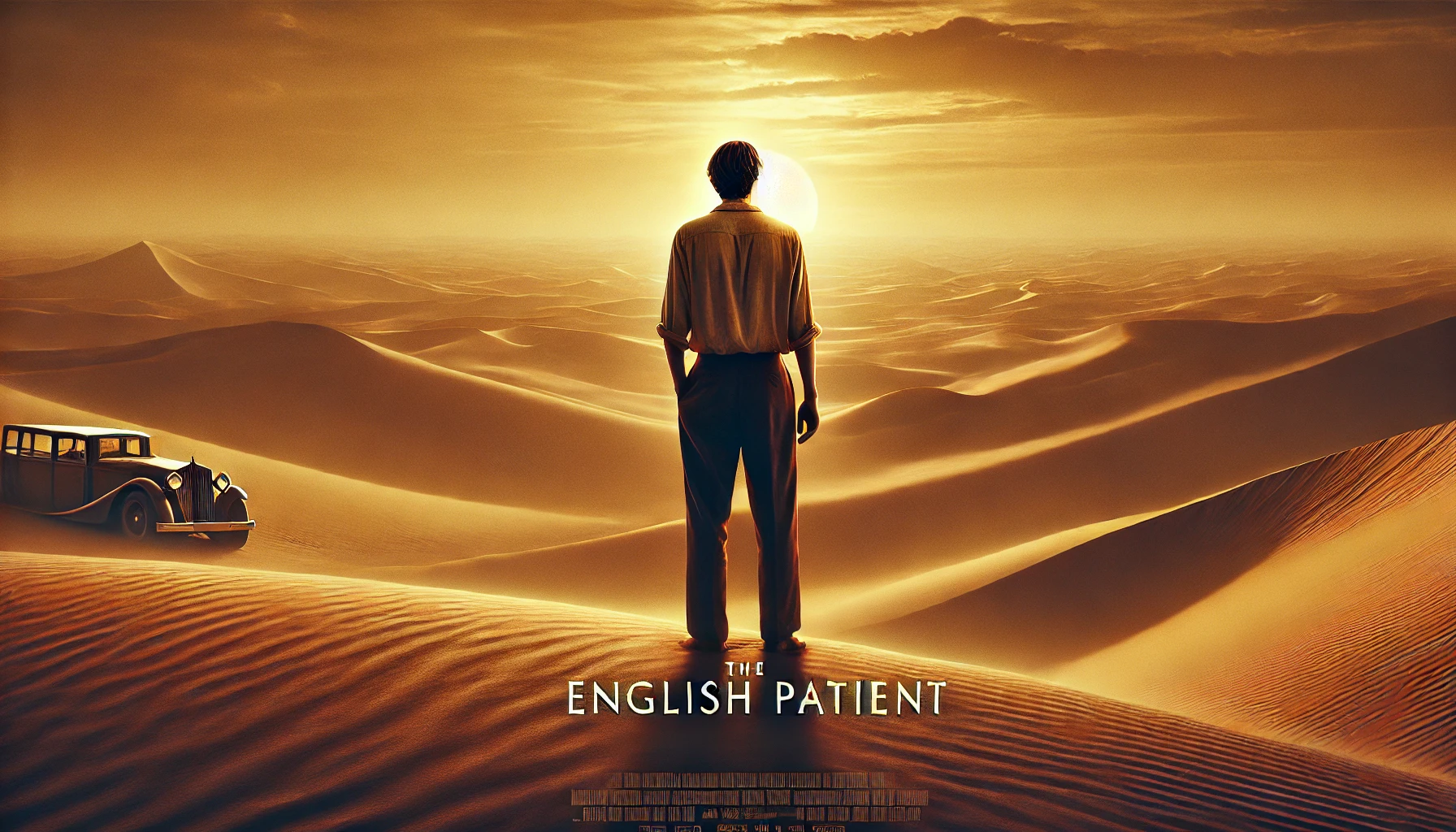
《The English Patient》 is a dirge etched by the sands on the ruins of war. The pallor of the desert engulfs borders but makes the searing scars of love ever clearer; names are erased from the flame-licked pages of old books while memories are reborn in more painful ways. Each frame is like a salt-soaked fresco – those faded flying skies crashing down in the church dome but always hovering in mid-air, like an eternal moment when we’re trapped in a rift in time and space. When Emarsh carries Catherine’s bones through the sandstorm, when Hannah lights a match to illuminate the crumbling frescoes in the ruined abbey, I suddenly realize that the most violent burnings are often meant to prove that something cannot be burned
Loving Each Other in the Ashes – What We Talk About When We Talk About Eternity
The moment the projector’s beam slices through the darkness, I always think of the match Catherine struck in the cave. Twenty-five years on, the film of The English Patient may be stained with the mold of time, but those desert-baked loves and wounds ooze blood anew in the pupils of every generation. In this age of storing memories in clouds of data, we need a film like this more than ever – it lets us touch how those war-scorched love letters grow into an eternity harder than diamonds in the ashes of civilization.
The desert is never the backdrop, but the most honest witness to love. As Emash’s fingertips brush over Catherine’s sun-drenched spine, grains of sand roll down her skin like an intimate string of years that refuses to be corralled by any clock. Our generation is accustomed to using cell phones to share coordinates, but in the folds of their hand-drawn maps, we see another truth: all boundaries marked by latitude and longitude will weather, but only a grain of sand on a loved one’s eyelashes can remain motionless in the hurricane of memory. At this moment, I am sitting in a late-night theater, the blue light of the neighboring girl’s cell phone screen reflecting the traces of tears, and suddenly I understand the forbidden love that grows in the heat of the desert – in today’s world of algorithms pushing love words, what we have lost is not the courage to do so, but the patience to let the pain naturally scab over.
Catherine’s last words, left on the rock face of the cave, are the last parchment scroll of an era filled with Wi-Fi signals. When she used her last strength to write “We are the real country”, the rustle of charcoal rubbing against the rock wall penetrated the screen and stabbed all the people who meticulously groomed their love on social networks. The intimacy measured by the number of likes, the thoughts replaced by emoticons, crumbled into pieces in front of the cave’s suicide note. I think back to last winter at the Mogao Caves in Dunhuang, where the guide’s flashlight beam swept over a portrait of a Tang Dynasty woman feeder, and the couple beside me was sharing the same pop song on Bluetooth headphones. Two “presences” separated by thousands of years collide in the cracks of space and time – we have never stopped writing softness on the hard world, we have just replaced the charcoal with pixels.
The way the fire licks the memory is more brutal than any cloud backup. The image of Emash walking into the fire with the skeleton of his lover in his arms reminds me of the box of flood-soaked love letters in the attic of my old house. My mother used to crouch in the yard in the height of summer to dry the pages, the water marks haloing the writing like crying lipstick. Now my love lies in an encrypted folder, where a single misstep can zero in on five years of light. The burning planes in the movie cast distorted shadows on the sand dunes, like the last chats of our generation before we broke up – those late-night sentences sent and withdrawn, those unfinished documents, all silenced into ashes in the data graveyard. When Hannah lit the damp frescoes in the abbey with a match, the leaping flames illuminated not only the faces of the saints, but also our losing ability to preserve memories with our body heat.
Names become the gentlest instruments of torture in the entire movie. When the label “The English Patient” covers Emarsh’s name, and when Catherine begs in her suicide note, “Please give me a new name,” I suddenly see the fate of the modern man in the quality of the 4K restoration. Our names are fissioning into social accounts, email addresses, and ID numbers, like remnants of countless parallel universes. Are those whose names have been wiped out by war, and our IDs floating around in the virtual world, all thirsting for a hand to claim their lost souls?
What always stung me the most were the murals in the Swimmer’s Cave. When primitive people 10,000 years ago depicted swimming figures in ochre, did they ever expect that these lines would shelter the most heartbreaking farewells of the twentieth century? The frescoed figures that Catherine looked up to as she died are floating on my cell phone screensaver right now – downloaded from a tweet by an art blogger. Our generation zooms through all of human civilization with our fingertips, but it’s hard to find a wall worth carving last words on anymore. As Hannah’s gondola carrying candles sinks into the depths of the mural, someone in the back row of the theater raises their cell phone to record the video, and in the cold light of the LCD screen, the ancient petroglyphs eerily mingle with the reflections of the electronics. This is perhaps the ultimate metaphor of our time: in the gap between the digital and the real, there is a cave in everyone’s heart that is weathering, waiting for a certain match to ignite all the sealed dawns.
By the end of the movie, I was reminded of Emarsh’s sand-filled pocket watch as he traveled through a sandstorm; the second hand had long since been rusted by time, but a single hair of Catherine’s will always be hidden deep within the case. In this age of swipe-and-get-everything, perhaps we need movies like this more than ever – a brutal reminder that all convenient storage is diluting the concentration of love, and all instant communication is killing the romance of waiting.
I suddenly long to buy a sheepskin notebook and write to someone in the clumsiest penmanship. Not the fleeting dialog boxes of WeChat, but the kind that gets ink on your fingers and letterhead with suitcase creases. Like Catherine’s suicide note had to be carried on a rock face, like Emarsh’s love poems destined for the margins of Herodotus’ annals – some loves inherently require a coarse texture, the desert, the fire and the smoke as a vessel, the determination to carve a name into a rock rather than a stream of data.
As the bandages of the English patient peel away in layers on the screen, are we not unsealing our own over-packaged affairs of the heart? Perhaps every era needs a fire to burn away those delicate social masks so that the moonlight can shine directly on the scars of the soul. Suddenly, I realized that what is truly immortal is always those things that have been polished by the sands of the wind and sand – such as the sins of those who love each other in the desert, such as the unsent love letters in the caverns, such as the flame that refuses to be extinguished in the eyes of those who refuse to leave their seats after the show has broken up.
—–TianaSkye


